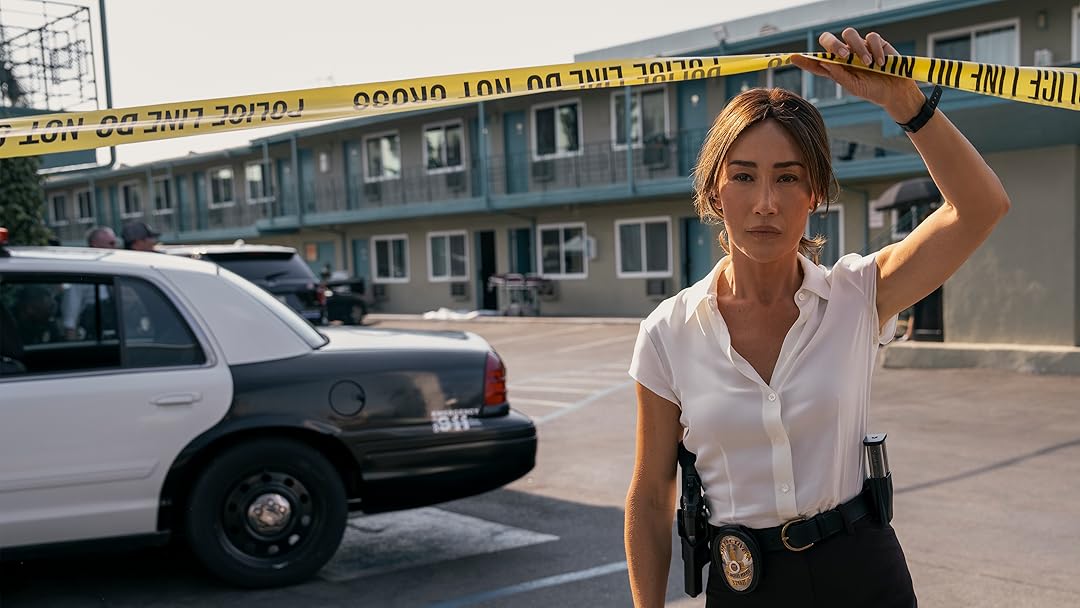
In the city of Los Angeles, where the ghosts of unsolved crimes haunt the city’s underbelly, Ballard arrives as a gripping extension of Michael Connelly’s storied Bosch universe on Amazon Prime Video. Premiering on July 9, 2025, this 10-episode police procedural is a spinoff from Connelly’s Renée Ballard novel series, with the bestselling author serving as co-creator, executive producer, and narrative guide alongside writers Michael Alaimo and Kendall Sherwood. Born from the success of Bosch (2014–2021) and its sequel Bosch: Legacy (2022–2025), Ballard shifts focus to Detective Renée Ballard, a tenacious LAPD officer sidelined to the department’s underfunded cold case unit after reporting a colleague’s attempted assault on her. Starring Maggie Q as the no-nonsense lead, the series delves into themes of institutional corruption, personal trauma, and the relentless pursuit of justice, blending procedural grit with the moral ambiguity of action & suspense narratives.
Season 1 of Ballard centers on Renée Ballard’s dogged investigation into a web of long-buried murders that exposes a sinister serial killer and a conspiracy rotting at the heart of the LAPD. The main plot kicks off with Ballard inheriting a basement office stocked with dusty files and a skeleton crew of volunteers, tasked with reviving cases the department has long ignored. The central thread revolves around the 2010 murder of Sarah Pearlman, sister of ambitious city councilmember Jake Pearlman (John C. McGinley), whose high-profile plea forces Ballard’s hand.
As she peels back layers of evidence, the case intertwines with the mysterious shooting of an unidentified John Doe in a rundown motel, revealing a pattern of 14 unsolved killings targeting vulnerable women over decades. These crimes, dismissed as isolated tragedies, form the serial killer’s trail. At the same time, the John Doe investigation uncovers suppressed 911 calls and ties to departmental cover-ups involving corrupt figures like Sergeant Robert Olivas (a cartel-linked officer played with oily menace by a recurring antagonist). Sporadic cameos from retired detective Harry Bosch (Titus Welliver) provide ballast, his rogue wisdom clashing with Ballard’s procedural purity as they chase leads from L.A.’s seedy motels to elite enclaves.
The season masterfully balances this serialized hunt with episodic side cases—a viral fraternity hazing death, a housekeeper’s unsolved stabbing—building a mosaic of institutional failure that culminates in a devastating reveal and a cliffhanger primed for escalation. Ballard Season 1 unfolds with the meticulous craftsmanship of a well-thought-out production, its 10 episodes dropping simultaneously for a binge-friendly immersion that rewards patient viewers. From the pilot’s tense opening—Ballard navigating her demotion amid flickering fluorescents—to the finale’s pulse-pounding arrest, the series maintains a taut rhythm, blending atmospheric L.A. visuals with Connelly’s trademark procedural authenticity.
However, I advise close attention to every dialogue and detail; like its sister show Bosch, Ballard layers subplots atop the core mystery without signposting, introducing red herrings and forensic nuggets that pay off subtly. Episode 1, “The Midnight Watch,” sets the stakes as Ballard pores Sarah’s file, discovering overlooked fibers linking it to older cases. At the same time, the John Doe body yields a bullet casing etched with LAPD insignias—hinting at internal sabotage. Bosch’s first appearance, a gravelly phone call urging her to “follow the money, not the manual,” underscores their stylistic divide:
Renée’s by-the-book diligence contrasts Harry’s off-the-cuff bravado, making their collaborations a highlight of intellectual friction. The narrative deepens in Episodes 2-5 (“Echoes in the Dark,” “Threads of Deceit,” “Buried Leads,” and “Survivor’s Shadow”), where Ballard’s team unearths the serial pattern: 14 women, mostly from marginalized communities, slain in ritualistic fashion over 20 years, their cases buried under bureaucratic neglect. A side plot involving housekeeper Yulia Kravetz’s 2015 murder introduces tension, as Ballard’s re-interviewing of witnesses stirs departmental pushback from Olivas, who stonewalls inquiries into the missing 911 log from the John Doe scene.
Bosch reappears in Episode 4, joining a stakeout that nets a low-level informant, his unorthodox tailing methods saving the day but earning Ballard’s eye-roll. This dynamic humanizes both without overshadowing her lead. The breakthrough comes in Episode 5, when Ballard locates Naomi Parker (Courtney Taylor in a standout role), a survivor maimed years ago but left alive as a “warning.” Naomi’s vivid recollection—a silver-haired man with a distinctive scar—provides a sketch and timeline, propelling the team to connect Sarah’s death to the spree.
Episodes 6-8 (“Digital Ghosts,” “The Interrogator’s Art,” and “Old Shadows”) ramp up the conspiracy, as John Doe is ID’d as a whistleblower threatening Olivas’s cartel ties. Ballard’s reserves shine here, and their “dorky” camaraderie—awkward team huddles over vending machine coffee—is belied by sharp contributions that make her success feel earned. The season’s emotional core builds toward the shocking twist in Episode 9 (“Fractured Lines”), where evidence points not to an external monster, but Gary Pearlman (a chilling guest performance by an actor channeling quiet depravity), Jake’s father, and a retired LAPD chief. Gary’s pathology, fueled by unchecked power and hidden trophies from victims, led him to silence Sarah after she stumbled on his secrets, mistaking them for infidelity clues.
The 14 murders, spanning his career, were covered up through influence and intimidation, a revelation that shatters Jake and indicts the system. Bosch’s final assist in Episode 8, decoding a cryptic ledger, seals the net around Gary. The finale, Episode 10 (“End of the Line”), delivers catharsis and chaos. Ballard tracks Gary to his home, a rain-lashed confrontation ending in his cuffing amid tearful denials. Jake’s devastation—confronting his father’s dual legacy—adds poignant weight, while Naomi’s closure offers a rare win. But the episode pivots to the corruption arc: Ballard corners Olivas for a deal, only for him to be gunned down at his doorstep, her phone pinging her at the scene. Arrested as the suspect, the cliffhanger frames her for murder, teasing a Season 2 dive into the LAPD’s rotten core.
Ballard’s reserve unit, a motley crew of volunteers, forms the show’s unsung backbone, their quirks endearing despite the “dorky” vibe. Dr. Elias Chen (Courtney Taylor, doubling as Naomi in a meta twist), the forensic pathologist, brings scientific rigor, analyzing trace evidence like DNA from Sarah’s scarf to map the serial timeline. The cybersecurity whiz, Officer Marco Ruiz (Enrique Arrizon), hacks archived logs to expose the buried 911 call, his tech flair cracking digital walls in Episode 6. The streetwise administrator, Sergeant Lisa Moore (Amy Hill), leverages her informant network for tips on Gary’s alibis and her no-nonsense grit steering stakeouts. Thomas Laffont (John Carroll Lynch), Ballard’s retired ex-partner, offers interrogation mastery and emotional steadiness, his subtle probing in Episode 7 unraveling a witness’s lies.
And intern Martina Castro (Victoria Moroles), the eager researcher, compiles victim profiles that reveal patterns, her fresh perspective injecting optimism. Though blandly sketched—lacking Bosch’s roguish flair—their skills synergize, turning Ballard’s isolation into a collective force. Yet, unlike Bosch’s vibrant ensemble, Ballard’s characters—including Renée—struggle to carve a unique identity. Maggie Q’s restrained portrayal captures Ballard’s stoic resolve, but the supporting cast feels flat, their blandness diluting the drama despite strong plotting. Renée’s trauma simmers but rarely boils over, leaving her more vessel than vivid hero.
Hopefully, a Season 2—demanded by that cliffhanger—will infuse personality, picking up with the Olivas frame-up and a deeper corruption hunt, perhaps exploring Ballard’s inner demons more boldly. Overall, Ballard Season 1 is a solid debut: its intricate mysteries, procedural polish, and ties to the Bosch legacy earn a perfect 100% on Rotten Tomatoes, making it essential for crime drama fans. The plot’s strength carries the bland edges, but future seasons need character spark to stand apart.