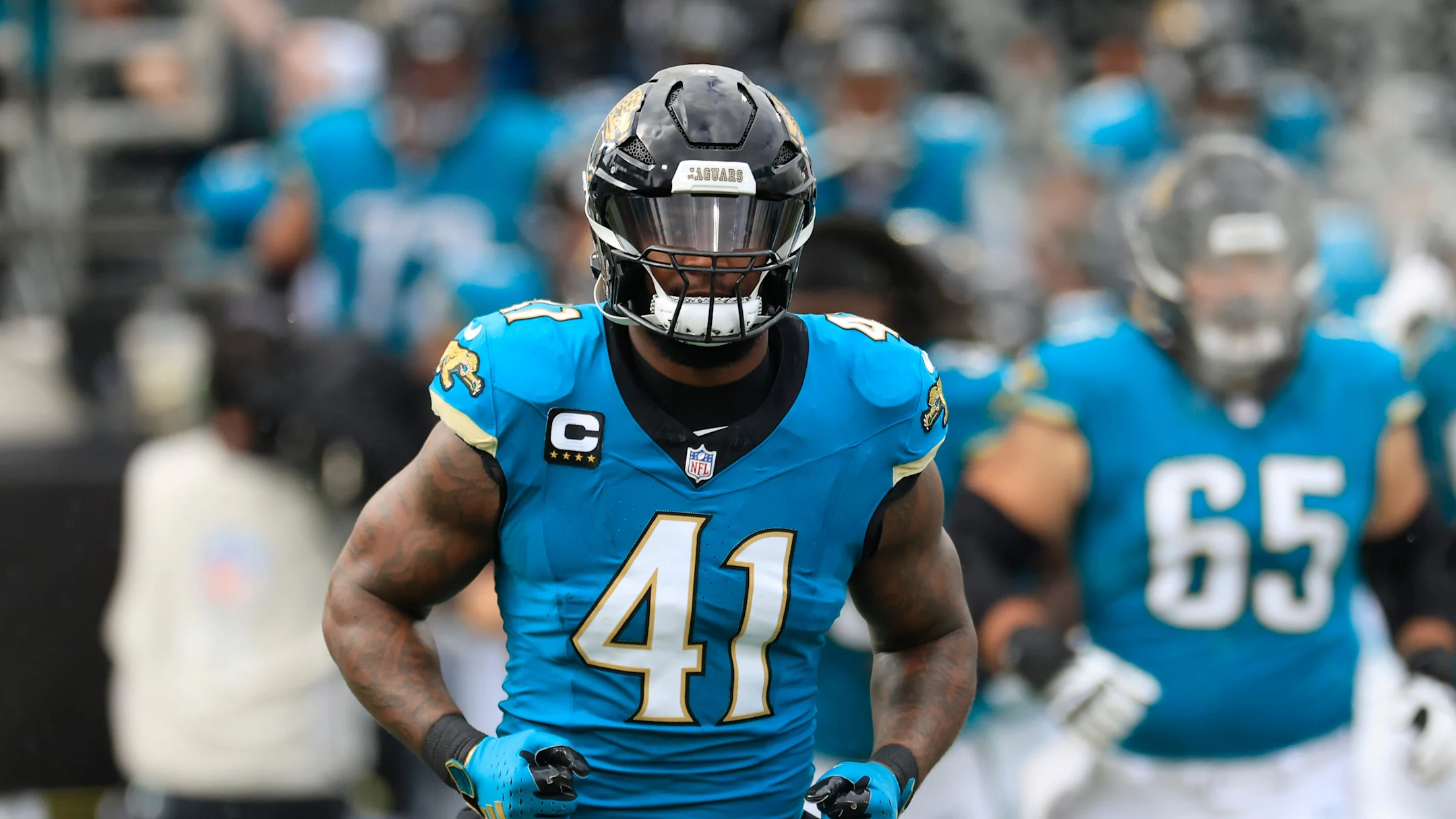
For much of the 2025 season, the conversation around the Jacksonville Jaguars centered on Trevor Lawrence’s evolution, Liam Coen’s offensive creativity, and the steady maturation of a young receiving corps. But while the headlines stayed glued to the offense, something else was quietly taking shape on the other side of the ball. What began as a unit with potential has now become one of the NFL’s most efficient, disciplined, and quietly dominant defenses. And if the Jaguars ultimately make a deep playoff push, it will be this group — not just the offense — that carries them there.
This transformation did not happen overnight. It emerged from a series of strategic decisions, key personnel developments, and a schematic identity rooted in discipline first, chaos second. The result is a defense that ranks near the top ten in success rate, EPA per play, and points allowed per drive. It is a unit that suffocates run games, forces quarterbacks to wait an extra half-second in the pocket, and creates just enough disruption at every level to tilt outcomes in their favor.
This is the story of how Jacksonville rebuilt, retooled, and ultimately rebirthed one of the NFL’s most efficient defenses.
The Foundation: Winning in the Trenches
Every elite defense in today’s league starts with trench dominance, and Jacksonville’s renaissance begins with two names: Josh Hines-Allen and Arik Armstead.
Josh Hines-Allen: A Star Fully Unleashed
Once known primarily for flashes of brilliance, Hines-Allen has become the consistency engine Jacksonville desperately needed. He no longer wins reps; he controls games. Offensive coordinators scheme entire protections around his alignment. Quarterbacks slide the protection toward him. It still often doesn’t matter.
Hines-Allen’s blend of athleticism, timing, and relentless pursuit has translated into some of the best EDGE metrics in the AFC. His pressures frequently come at the most impactful moments — third downs, red zone snaps, and must-have defensive stands. He isn’t simply padding stats; he is resetting the tempo of games.
Most importantly, his dominance has opened doors for everyone around him.
Arik Armstead: The Stabilizing Force
On the interior, Arik Armstead has delivered exactly what the Jaguars envisioned when they prioritized acquiring a veteran defensive anchor.
Armstead is not always the player fans rave about, but coaches do. His ability to anchor against double teams, recognize blocking schemes pre-snap, and collapse pockets from the inside has dramatically improved the structural integrity of Jacksonville’s defense.
When opponents try to run inside zone or power looks, Armstead disrupts timing. When they attempt bootlegs or play-action fakes, he sets anchors that force quarterbacks into uncomfortable half-rolls. When they try to attack with quick-developing runs, he forces immediate redirection.
Together, Hines-Allen and Armstead form a trench duo that has taken Jacksonville’s front from solid to one of the most efficient in football. Their impact flows upward into every level of the defense.
The Second-Level Solution: Devin Lloyd’s Growth
If the Jacksonville defense has a heartbeat, it is Devin Lloyd.
Once a linebacker with tremendous athleticism but inconsistent eye discipline, Lloyd has blossomed into the stabilizer that ties the entire unit together. His play has become more instinctive, more controlled, and more consistently impactful.
Lloyd’s progression particularly shows up in:
• Early-down run fits
He diagnoses blocking schemes more quickly and attacks with greater precision, helping to limit opponents to minimal gains on first and second down.
• Pass-coverage drops
Where he once hesitated, he now triggers immediately — squeezing throwing lanes, jumping crossers, and eliminating tight end mismatches.
• Leadership
He handles calls cleanly, getting the defense aligned quickly and confidently, giving Jacksonville one of the smoother pre-snap operations in the AFC.
Lloyd’s improvement is a major reason the Jaguars rank among the top ten in defensive success rate. Stopping early-down efficiency is the foundation for forcing higher EPA per play from opponents — and Lloyd has become the catalyst for that shift.
The Secondary: Disruption Through Discipline
Jacksonville’s pass coverage doesn’t rely on exotic, high-risk schemes. Instead, the Jaguars have quietly built a secondary that thrives on squeezing windows, delaying quarterback decisions, and giving the pass rush the extra beat it needs.
Tight coverage = delayed throws = pressure opportunities
Opposing quarterbacks have been forced into hesitation throughout the season. Even if completions occur, they tend to be contested or arrive short of the sticks. That delayed processing time is precisely what allows Hines-Allen, Armstead, and the rest of the front to generate pressure without needing heavy blitz volume.
Jacksonville’s corners have improved significantly in:
• Hip transitions
Allowing them to stick closer to intermediate routes.
• Timing at the catch point
Reducing yards after catch and eliminating cheap conversions.
• Communication on switches
This vastly reduces breakdowns on crossers and bunch sets — a weakness in past seasons.
The result is not a flashy secondary that produces gaudy takeaway totals, but a smart one that complements the pass rush and plays assignment-sound football. In today’s efficiency-driven NFL, that matters more than ever.
The Metrics Tell the Story
Efficiency statistics validate what the film shows. In the Jaguars’ last six games, the defense ranks:
• Seventh in EPA per play allowed
EPA is one of the clearest indicators of how much each snap affects the win probability. Jacksonville consistently pushes offenses backward.
• Seventh in points allowed per drive
A top-ten measure of finishing defensive series without damage.
• Thirteenth in success rate
Meaning Jacksonville forces low-value plays often enough to dictate game flow.
Weak opponents don’t inflate these numbers. They reflect sustained performance against quality offenses and quarterbacks. And importantly, they mirror the eye test — a defense that relies on cohesiveness, patience, and a well-planned approach.
A True Identity Shift
While the offense continues to draw headlines, the Jaguars have become a balanced and complete football team. And it is the defense that has matured into the true backbone of their playoff hopes.
The front dominates structurally.
The linebackers clean up efficiently.
The secondary disrupts rhythm.
Everything works together, not as isolated standouts but as a unified philosophy.
Jacksonville no longer needs shootouts to win. They don’t depend on high-variance plays or offensive fireworks. Instead, they rely on sustainable, repeatable defensive efficiency — the very metric that often separates playoff pretenders from true contenders.
The Road Ahead
As the Jaguars push toward the postseason, the national narrative will eventually catch up with them. Analysts will begin highlighting the top ten defensive metrics. They will mention the trenches. They will underline Lloyd’s rise and the secondary’s tightening coverage. They will cite the EPA and success-rate numbers.
However, internally, Jacksonville has known for weeks that it has built a playoff-ready defense. And the league is starting to notice.
Their offense may be the storyline.
Trevor Lawrence may be the face of the franchise.
But the defense?
The defense is becoming the soul of the team — a reborn unit that is no longer overlooked but instead sets the tone for everything the Jaguars aim to achieve.
If this group continues to play at this level, Jacksonville will not just be a playoff team. They will be a playoff threat. And they will owe that rise to a defense that quietly turned itself into one of the most efficient units in the NFL.